

What is DeepSeek super agent?
DeepSeek super agent is a useful search name for the dsh-superagent research prototype published by the DeepSeek organization. It explores how a coding collaborator can receive events, apply authorization rules, organize work into Tickets, and return useful results without asking a person to manage every individual session. The public repository describes a system for one GitHub repository, with optional Feishu integration. It is distributed as a bundle for DeepSeek Harness, the environment that hosts its agent sessions and tools.
DeepSeek super agent is explicitly described as research code rather than an official DeepSeek product. That distinction changes how you should evaluate it. A public implementation gives developers something concrete to inspect, but it does not establish a supported hosted service, a reliability guarantee, or a finished consumer application. Some ideas from the associated design discussion are future directions rather than completed features. Start with the official README, then use this independent guide to connect its terminology to practical decisions.
The central idea behind DeepSeek super agent is the cost of human attention. A system that produces more messages, more unfinished branches, and more decisions can make a team busier even when its models are capable. The prototype therefore gives events an explicit route, gives work an identifiable scope, and surfaces situations that require a person. Useful autonomy includes knowing when to remain quiet.
How a request becomes useful work
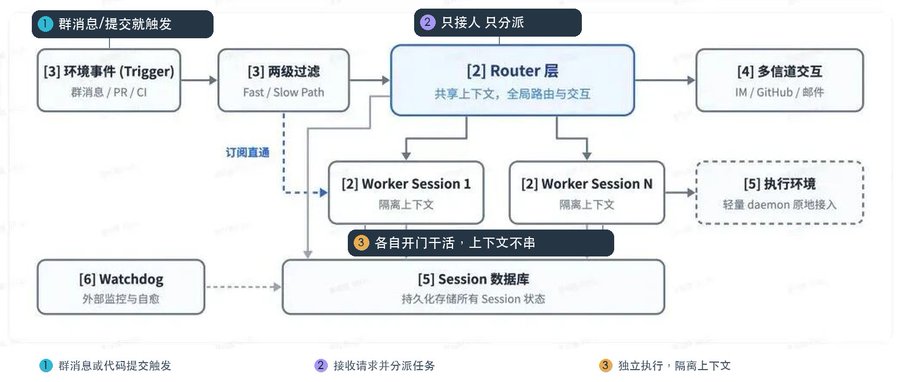
Imagine a developer discovering a misleading error message in a repository. With DeepSeek super agent configured, an allowed person posts a new GitHub comment that directly mentions the dedicated agent account and describes the expected correction. The incoming event is recorded, checked against policy, and evaluated for routing. An accepted request creates a Ticket representing the work and its authority. The executor prepares a directory and runs a worker session for that Ticket.
A DeepSeek super agent worker can inspect the repository and use the available tools within its task. The exact outcome depends on the model, environment, instructions, repository, and request. A possible delivery is a pull request with an explanation and validation results. This site does not claim that every request produces a correct patch. Human review remains a practical part of accepting a result, especially while a team learns how the system behaves.
Follow-up messages matter as much as the initial request. DeepSeek super agent keeps relationships between a Ticket and its subscribed conversations, allowing relevant context to reach existing work. A message arriving as context is not automatically new authorization. This separation helps explain why a system can listen broadly while acting narrowly. The architecture guide traces those boundaries in more detail.
Why the word “super” needs context
The phrase DeepSeek super agent describes this specific project in our guides. The broader phrase “super agent” is used by different companies for different products and architectures. A shared label does not imply shared code, identical capabilities, or comparable pricing. Genspark’s general task assistant and ClickUp’s workspace agents address different environments from this repository-focused prototype. Choosing among them starts with the work you actually need to complete.
DeepSeek super agent is relevant when you want to inspect how persistent coding collaboration is organized. It is less direct as an answer to someone who only wants an immediate browser assistant for everyday office work. A developer evaluating an open implementation may value source access and configurable policy. A nontechnical user may value an existing managed experience. Neither preference makes one category universally superior.
Our comparison guide uses practical dimensions: task scope, deployment responsibility, data access, human review, and operational effort. DeepSeek super agent should be compared using those dimensions before discussing speed. We have not run a controlled benchmark against commercial alternatives, and community performance numbers are not presented as our own results.
Four concepts worth understanding first
The first concept in DeepSeek super agent is a Source: an integration that brings events into the system. GitHub and Feishu are the published integrations relevant to initial setup. A Trigger is an individual event. A Thread groups related events in a conversation so the system can reason about continuity. A Ticket represents accepted work. Keeping these concepts separate helps you understand both normal execution and troubleshooting.
The second concept is authority. DeepSeek super agent uses policy, allowed senders, and Mandates to distinguish information from permission. A copied document can contain instructions, but that does not make its author an authorized operator. An automated event can provide useful context without acquiring the ability to stop work or expand its scope. The host and policy layer enforce important parts of these distinctions.
The third concept is execution. DeepSeek super agent gives a task its own session and directory, which helps organize parallel work and reduce accidental context mixing. A separate directory is not a hardened sandbox. The deployment documentation states that the worker runs with the operator’s operating-system privileges. Plan machine isolation separately from task organization.
The fourth concept is attention. DeepSeek super agent tracks whether a task is working, waiting, or needs a person. A useful operator panel should let a reviewer identify the next decision without reading every intermediate tool call. This makes the project interesting as an interaction design study as well as an implementation reference.
Start with a narrow, inspectable setup
A sensible first DeepSeek super agent experiment uses a small repository, one allowed requester, a dedicated agent identity, and a task whose result is easy to review. A documentation clarification or a small test correction is easier to inspect than a broad architectural rewrite. Define what success means before sending the request: the expected files, the validation command, and the person responsible for review.
DeepSeek super agent requires an appropriate local or dedicated machine environment. The published prerequisites include Node.js, pnpm, Git, Python, tmux, GitHub CLI, and a compatible DeepSeek Harness version with a model provider configured. Versions can change, so the current package metadata and deployment document are the authority when you install. This site explains the workflow rather than promising that one copied command works indefinitely.
The setup planner prepares a brief from non-sensitive choices. It does not install DeepSeek super agent, call a model, connect your GitHub account, or verify the machine. Its output helps you explain your intended boundaries to a local coding agent following the upstream setup instructions. Tokens and app secrets never belong in a public planning form.
Understand off, observe, and auto
DeepSeek super agent separates explicit requests from inferred candidates. An explicit request comes through an authorized route. Inferred work is work the system considers from other admitted events under written rules. The accept mode controls this second category. Understanding that separation prevents a common mistake: assuming observe mode makes every possible action read-only.
In DeepSeek super agent, off disables inferred candidates. Observe allows eligible inferred candidates to be assessed and records a positive assessment as “would accept” without executing that inferred work. Auto can accept inferred work when its rule requirements are satisfied. Authorized explicit requests can still work in every mode. The interactive model above illustrates the distinction without connecting to a real repository.
Begin a DeepSeek super agent rollout with policy you can explain in a few sentences. Review observations before enabling automatic admission. Name who can request work, which conversations count, and what review the result requires. Avoid treating a long system prompt as a substitute for explicit permission settings. The authorization document is the primary reference.
What the visuals on this site represent
The DeepSeek super agent illustrations on this site are original conceptual artwork. The luminous whale and connected nodes communicate coordinated intelligence; they are not screenshots of an official product or evidence of a working deployment. Our original videos explain the sequence of events and policy modes. Their labels identify them as conceptual demonstrations, and their adjacent text provides a readable explanation.
DeepSeek super agent reporting on X adds another perspective. We link the original authors and distinguish their commentary from repository-backed facts. A screenshot in a social post may describe an internal experiment or a broader architectural proposal. Before using its claim to make a deployment decision, check whether the public prototype implements the same mechanism and whether the reported setup matches yours.
Videos start muted and loop automatically when visible, subject to browser preferences. You can pause motion using the footer control. DeepSeek super agent content remains available as text even when animation is disabled. That is important both for accessible reading and for visitors who want to understand the project without watching a moving diagram.
Questions to ask before investing more time
Ask what a DeepSeek super agent instance would remove from your workday. Would it handle issue intake, preserve follow-up context, or reduce repetitive coordination? Then ask what new responsibilities it creates. Someone must manage the environment, credentials, policy, repository access, upgrades, and review. A useful experiment compares those responsibilities with the coordination effort saved.
Ask how DeepSeek super agent will fail in your environment. A model provider may time out, a CLI may use the wrong account, a prepare command may fail, or an event may never become an admitted request. These are different problems and need different checks. Our troubleshooting guide organizes investigation around the stage where progress stopped.
Ask what evidence you need to continue. For DeepSeek super agent, a successful startup is only the first layer. A real acceptance exercise should follow a permitted request through a Ticket, worker activity, a reviewable result, and a controlled stop or recovery. Record the tested upstream revision, provider, and limitations. Avoid generalizing one successful small change into broad production readiness.
Keep the source and the promise aligned
DeepSeek super agent is worth studying because it makes concrete choices about event intake, persistent work, and human involvement visible. That does not require overstating what it can do. A clear distinction between a research prototype, a design proposal, and a managed service makes the project easier to evaluate. It also makes your own experiments easier to explain to colleagues.
This independent DeepSeek super agent explorer is organized around that distinction. Read the complete guide for orientation, the architecture page for mechanisms, the installation page for prerequisites, and the planner for a portable brief. Use the source links to verify details that affect your environment. The next useful step is a small, well-scoped experiment with a clear reviewer and a result you can inspect.